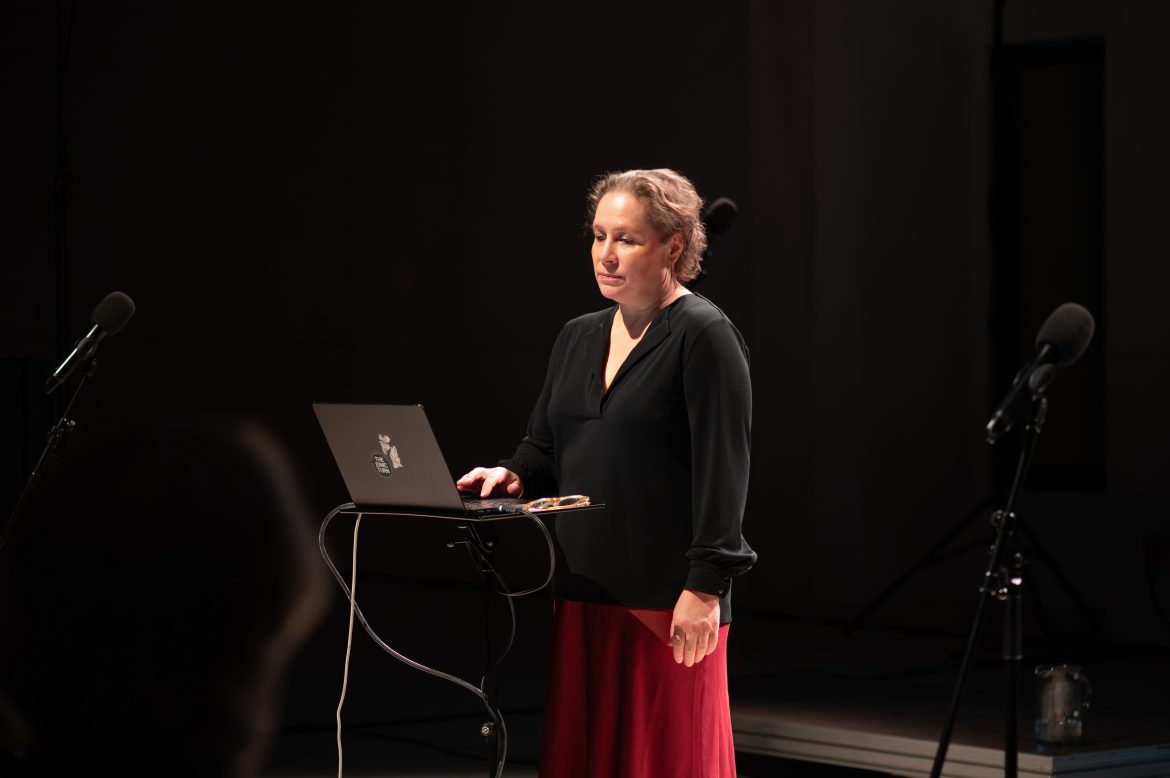
On September 23rd, on the day of her curatorial performance no signal at the TO)pot festival in Ljubljana, we met with the artist, researcher, and writer Salomé Voegelin in the café of Hotel Park. Voegelin is currently based in Berlin, serves as a Professor of Sound at the London College of Communication, University of the Arts London, and also holds an academic role in Bern, Switzerland. Known also for writing text and conceptual scores for music and performance, she has released projects on the Flaming Pines record label, including Cassette Album (2025) and Paint your lips while singing your favourite pop song (2022). She is the author of several influential books exploring the philosophy and politics of sound, including Listening to Noise and Silence: Towards a Philosophy of Sound (2010), Sonic Possible Worlds: Hearing the Continuum of Sound (2014/21), The Political Possibility of Sound: Fragments of Listening (2018), Uncurating Sound: Knowledge with Voice and Hands (2023), and Unperforming the Dream House (2023). In our conversation, we discussed her early formative experiences with sound, her critique of dominant visual object-based knowledge, the concept of the no signal, and the political potential of sonic thinking in contemporary art and academia.
Before we get into your work, I wanted to know if you could tell us something about your upbringing: your family, your early influences, even before school and academia? So what in those kinds of early environments was formative towards who you are now in an intellectual and artistic sense?
Sometimes I find these sort of origin stories really difficult. I don’t think much about how I came to sound, but actually there are, I suppose, formative moments. I was brought up my first nineteen, twenty years in Switzerland, which is an extremely conservative, patriarchal place. I found that more as I moved away from it. My first understanding of maybe not quite seeing the world like others do was when I went to school, and I wasn’t very good at primary school, and I don’t think it was because I was particularly stupid, but I think I really genuinely didn’t quite understand how we had to learn and maybe what we had to learn. I couldn’t quite understand the institution of school and what one was supposed to do there. And one way this manifested itself was when I had to learn the recorder, because you have to either learn the xylophone or the recorder at school …
So, the flute?
Yeah, and we had a very difficult teacher, who also turned out to be difficult in other ways –, but it was my first, sort of, brush with music beyond the piano, and it was not positive.
We had a piano at home from an aunt, who just, sort of, posited it there, and we would, sort of, you know, bash about on it, and that was fun, but then I had to learn this recorder, and I realised that I could not cope with the score, and I wouldn’t, I couldn’t do that. I just couldn’t do that, and it was a very painful experience, because the teacher was very unappreciative of my improvisations, and of what I did with it.
How old were you then?
Six, five, six years old, yeah. And then I got the chance to learn the piano with the Suzuki method, which is this method where you listen to, then, audio tapes, and you play by ear, and while I would certainly not say I reached any virtuoso standards, it was another way in for me. It was a way from listening into making music, into making sounds, into listening, and I think that opened a realm of being in the world which was more agreeing with how I saw or experienced the world.
I then repeated a class in primary school, because I couldn’t function academically, and I think that was really important – what happened in that year, because it’s sort of a year of finding out you’re not like those others who just move on.
Something’s not quite right, which obviously has all sorts of repercussions, and then the kind of inevitable, well, I can fit in, I can get the good mark as I move on, but I also realised there’s something else, and that something else for me became sound, became music, because the world for me became more accessible in that way, not even in a sort of, like I said, musical virtuosity way, but in a way of … I think the way I hear the world, if one could see the world the way I hear it, that it is more like the world I see. What I mean by that is, when we think sound, we appreciate that it is not this or that, it is relationships, it’s the in-between, it’s the ephemeral, and it’s always about reciprocity and about encounters, it’s not ever anything on its own. So if I clap my hands, it’s not this hand or that hand that makes the sound, but everything that vibrates together in this moment of clapping, and I think that is the way I felt I saw the world, and in hindsight I can understand why maybe some of the organised, categorised and classifying, learning and academic work that is demanded in school did not entirely agree with me, but then through making music, studying music for a while, and then going to art school at Central Saint Martins in London to do film and video, because there was no sound studies courses, helped because you could now work with technology – there was a little Akai sampler, there was a little MIDI keyboard and a small little square Mac, and I could sort of remove myself from the classical music I had trained in so far, which has also got its categories and its institutional set-ness and expectations that I really struggled with, and I could start to do stuff with sound, and understood this coincidence between how I see the world and how I think the world, and sound, and that sound was my way of thinking the world, and it became my sort of theoretical tool and material to think with.
For somebody else it might be smell, or it might be touch, I’m not wanting to privilege sound in any way, and I don’t want to set up an essentialism, because for me it’s not this kind of, oh, sound would be better, anti-visual stance, but rather it is through sound we can see something else, and we can see the world in a different way, and that different way, this relational, interdependent way, to me, seems a very important way to see the world, particularly now, at this political moment of rising authoritarianism and a rising right wing, and also with the planetary crisis and environmental issues, because a sonic vision does see how things relate, and therefore starts from that indivisibility, from how things are always already together, rather than apart, that we can bring together, or keep separate.
You talked about your struggle with the schooling process, but you do now also work inside an academic, also a media, and also an arts infrastructure, right?
Yes.
So institutions. How do you navigate that? Does your work stay independent from the authority of the dominant knowledge structures, even while operating inside them, I guess? How do you mediate that?
I think I had the great chance, privilege, to … Oh, rather let’s start here – when I was 20, I moved to England, to London, and it was in part because I … at the time, and I wanted to be in Europe.
I wanted to be in Europe, and so I went to England, because it offered something to study art and music there in a different, more open way, and to be with people there, it seemed to fit. And what it allowed me to do was to reinvent myself beyond the person I had experienced, quite a pained person I had experienced in Switzerland. A person who couldn’t quite fit in and struggled with different issues.
One advantage was the English language. It allowed me to think differently, because it has a huge vocabulary, but less strict grammar. And you can think a lot with English, because you can make nouns into verbs, and everything can become a process and the action that sound is, that is much harder to do in German or in French.
It’s wonderful how my sonic thinking of the world could find its own vocabulary, from sound, that became very soon one of my goals and aims.
Sorry, may I, it’s just too tempting … Did you learn English as a young person?
Not really.
So this was something that was a part of a kind of a struggle a little bit later in life?
Yes, because I stupidly chose Latin and Greek in school, and therefore started to do English later at about 16, and you learn sort of a bit of English at school, but it wasn’t to a level you could really happily communicate in.
You didn’t »think« in English?
No, not at all, not at all, and so when I moved to England, obviously that had to happen really quickly, I went to an art school, so the emphasis wasn’t on language, it was on doing stuff, which was more my kind of thinking, thinking through the material processes, but then I had some wonderful teachers and just the opportunity in an international environment where maybe there is more patois, there is more inventing of language, very few people I met were native English speakers, so I felt comfortable inventing what this English could be, and found the kind of, if I can say, a kind of, a temporal home in the language that I now think was about sound. I rarely write in German or French about sound. For me the grammar, the structure of these languages doesn’t quite fit the process-basedness of sound
So that was a really important move, and it was important to do that, and what I loved and love, and why Brexit was such a huge shock for me, as was the monetization of education in England. That too was such a huge problem.
After my BA and parallel to doing my PhD, I got into academic work, not because I had all of a sudden developed an appreciation and an ability to do academic work, but because the English academic system, particularly in the arts and humanities, has or had (it’s under threat now) an extremely anarchic streak, where it is not about learning so much about the past and quantification, but about doing the present and thinking about the future, and it’s very … it is not like in, particularly not like in Germany, where there is a sense of knowledge that the teacher gives the student, it’s much more about thinking together and generating knowledge together, and this more anarchic notion of knowledge, or this more process-based notion of knowledge, really worked for me, and is really how I thought, and how I could find an idea and a confidence that I can do this academic stuff that I was told I couldn’t do, I can do it within this context, and it became also maybe a passion to pursue and promote that this is how it can and needs to be done. Not this learning by rope, and being able to recall, and this references to the canon, and this display of historical, scientific, objective knowledge, but it’s about the knowledge we can produce together from an involved, plural and a responsible subjectivity.
And maybe that’s why when first the monetization of education happened, which lost us a lot, particularly in the arts and humanities, and then Brexit happened and amplified this loss for English higher education, I was devastated. English Higher Education is to my mind still unique and decidedly different from most European Systems. But it is really under threat particularly in the Arts and Humanities, and that frightens me, because I believe an artistic thinking can introduce more sound into education and thereby introduce its relational, and interdependent sensibility, and thus introduce the idea of the indivisibility of the world into education, which is something we desperately need to deal with current political and environmental crises and the pattern and frequency thinking of an AI world.
Me, personally, I’ve often felt that music is how I understand the world the best. For me, that is a really simple statement. Abstract, simple. So, looking at your work, I wanted to know what drove you early on, before the academic career? Your work today is clearly driven by political thinking, I think maybe even more and more with the years passing. But at the very start, what was it actually? Was it an epistemologic interest, an ontologic interest? Was it aesthetics, or was it really de facto political from the start, and those other things are just, like, more maybe tools to deal with the world?
I think in hindsight I can absolutely see how I had a desire to make sounds, but what was offered in my education was music. You can do sounds, you can do music. So I just assumed that if you want to do stuff with sound, you have to do this music stuff, because that is stuff with sound. And there wasn’t, either from my home environment nor from other influences, other ideas what sound could be and how it could be made. While I knew a lot about contemporary visual artists and performance artists, in school we’d get stuck somewhere with Hindemith, you know, sort of around 1940, 1950. I think we once briefly looked at Serialism, Schoenberg and Webern, and that was it. That was only looked at, literally looked at. We looked at the 12-tone system. We didn’t actually listen to it, I think, because our teachers couldn’t cope with the sound and what that listening might mean, and thus accessed the sound from the score.
Briefly …
Yeah, serialism was briefly looked at but that was it, the end. And so in music education we’re always about seventy or even eighty years behind, and whereas in visual arts education we did actually look at more contemporary work. So I didn’t have a sense that there was a doing stuff with sound that I could have done instead of music.
So there was a desire to do things with sound, and I think there was a political desire, because very early on there was a very feminist understanding of a lack, an understanding of, hey, we’re only playing white dead composers, I’m only practising white dead composers. Very early on as a young woman, you sense that I’m not here in the repertoire; these are not my sounds, as Hélène Cixous would say, you don’t find yourself in history. So what her suggestion is, is to invent yourself. You don’t go into history to find yourself, go into the future to find who you could be. And so I think that was always already there as a kind of political drive to not trust or not be that bothered with history, historical musicology, canons and great works, because I clearly wasn’t there.
And I think that was a spirit that worked quite well in England, in order to say, okay, I actually don’t have to do this school stuff. The first year I was there, I still tried to do classical music, I still tried to work that way. And then through film and video, I could free myself by making sounds with this Akai sampler, which was really important. It sounds silly, but a sampler was important to free myself from the notion of music and move into sound, because I could now record things that interested me, that were important to me. I could record them, and this was a sampler that I could maybe playback ten seconds. And there was no audio software, just MIDI, a Cubase MIDI programme.
But it’s a radically different approach to time in music, if nothing else.
Absolutely, and a radically different approach to virtuosity, to scales and harmony, to what music could be. And I think that was important. And also my teacher in film and video was Peter Cusack, which was really important, to have a sound person, a musician turned field recordist on the staff of the Film and Video course was amazing for me.
Also the move to England, understanding that there was a separation, a political separation between Switzerland and Europe, and starting to understand what partition meant, what separation meant, what politics meant. It just became stronger and stronger. And whereas, for example, my first book, Listening to Noise and Silence, is still very much about sounds and figuring out how one could write about that, how one could have a language, a sonic language about sound rather than a visual language about music, to really figure out what sound does, rather than what the visual language can do in its understanding of sound, which is an important difference.
Because when I write, what’s exciting about writing is that you discover things that you didn’t know before you started writing. So it’s not writing down knowledge, it’s making, doing, practising knowledge. That’s where theory as such doesn’t interest me. What interests me is practising with theoretical things. A writing that is maybe also shunned by a few people or by a few music departments, because they think this is not really musicology, this is not really what we can work with. And so it becomes inevitably more and more political, because you realise that if you can write a different world and think a different world, that means there is a plurality of worlds, that means decisions are taken somewhere to establish ideologically and politically what is real, what is normal what should be taught and what not. And so all the violence, all the asymmetries, all that doesn’t work in the world, are not an accident, they are so by the design, the political and economic design of the world. And if you can use sound to think it differently, you can also use sound to design it differently. And I think that’s how my practice and writing inevitably became political.
So this next question is very basic, to kind of create proximity between the reader and your general work. Could you explain as simply as possible two of the cornerstones of your work? So, first, your critique of the dominant visual object-based way of knowing, and then this idea of no signal as it relates to meaning before signification, and what you call the preliminary sense?
So let me have a go at the first one first, and maybe ask you again about the second one later. What I want to make really clear, and it’s really important to me, is that my thinking through and with the sonic is not anti-visual. It is not about saying we shouldn’t look, but it is an invitation to look differently, to see more. So it is not, as Jonathan Sterne calls it, an audiovisual litany, I really resent that term, and I like a lot of his other writing, but I resent that suggestion and its notion of the sonic thinker as a complainant of the visual dominance. In part because I think it’s a misunderstanding of subjectivity and positionality vis-à-vis the sonic and the visual. This is in part and again a feminist position that appreciates that if you’re not in the centre of discourse, if you’re not a white man, and not all white men are in the centre of discourse, I mean, actually maybe we better talk about a particular masculinity that is at the centre of discourse, and that excludes many, many male and male identifying people, that then from this marginality or relative marginality have to try to find another way to access the world that corresponds more with how we each resonate, or don’t resonate with it. And for me this other access point is the sonic, and the sonic is what can make us see more and differently. And so it is not a litany but a very clear, unsentimental quest for a more complex, plural and maybe even contradictory view.
As a white European woman, I’m not that marginal, I understand that fully, but am just a little bit off-centre, and so I can see that there is a centre and that I’m not part of it, and I have experienced that many times in my life, this not being part of it, and that others are even less part of it, and that therefore the engagement in sound as a pluralising or even erasing of the visual centre is not a litany, it’s not a complaint. It is an understanding and a sensibility of the fact that the visual norms we have and practice, and by this I mean a cultural visuality as in a culturally entrained visuality makes us see certain things and not see others, and that makes us see these things in a particular way: in a European way; in a very modernist way, in a post-enlightenment modernist way of use value, that is driven by the desire to measure and to classify things, to establish a modernist, metric and categorisable knowledge of the world, and that also includes the ability to map , to do cartography; to know where things are in order to go and get them, to colonialise them, to extract them.
So that is one visuality, one cultural visuality, and we could look at the world very differently. We could look at the gaps in between things and how things relate and how they are together, to instill and practice a different knowledge culture, where we know with, but not to have. But the way we are entrained into visuality from school, we have to learn about the measurement of things and what they mean and what they do, rather than how things relate and what they do together and in their interdependency. In Geography, you learn about rivers and maps and what is a country and what are the borders. How about learning about the in between and what they would be together. It would make a completely different – a sonic geography. So that is how I am not against the visually, complaining about its dominance, but want to challenge its cultural parameters and imperatives, I want to practise a different looking so that I can see differently, so that I can think differently, and ultimately it is a multi-sensoriality really, that I am after, as a paradigm shift into thinking and being and knowing with, which I feel we desperately need at this moment of environmental and political crisis.
And then there was the second point.
The no signal and what I said, the preliminary sense or meaning before signification.
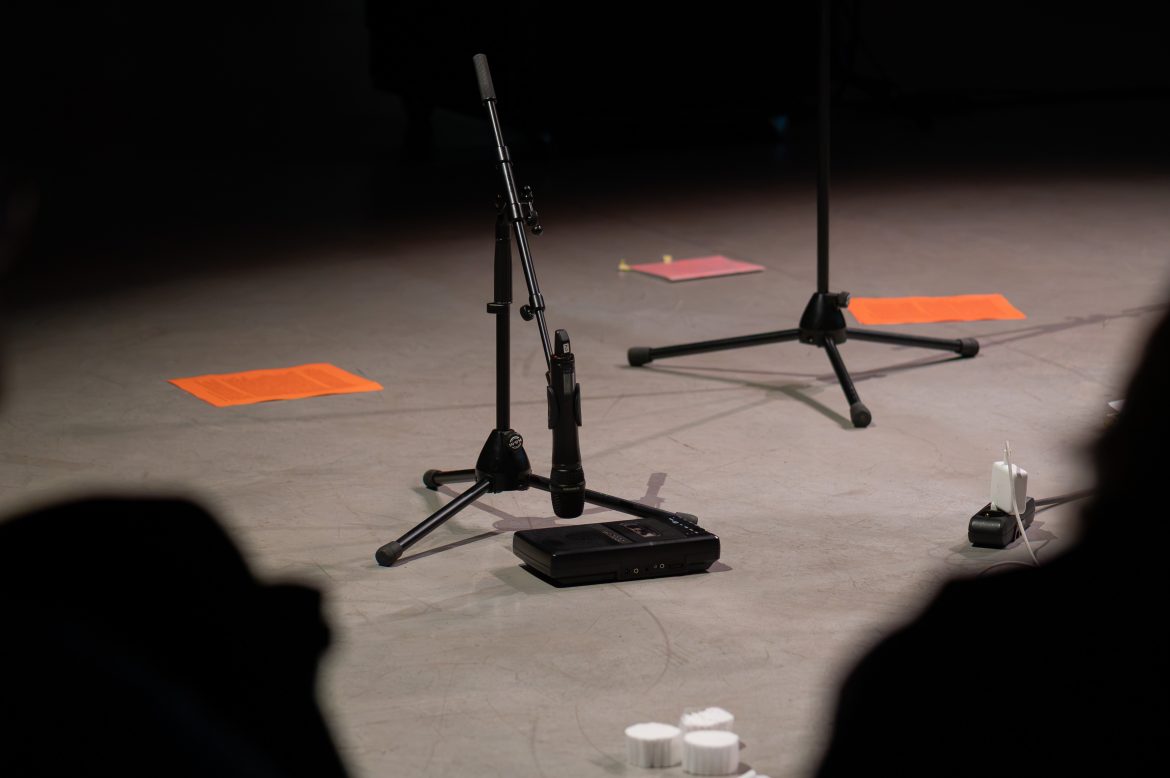
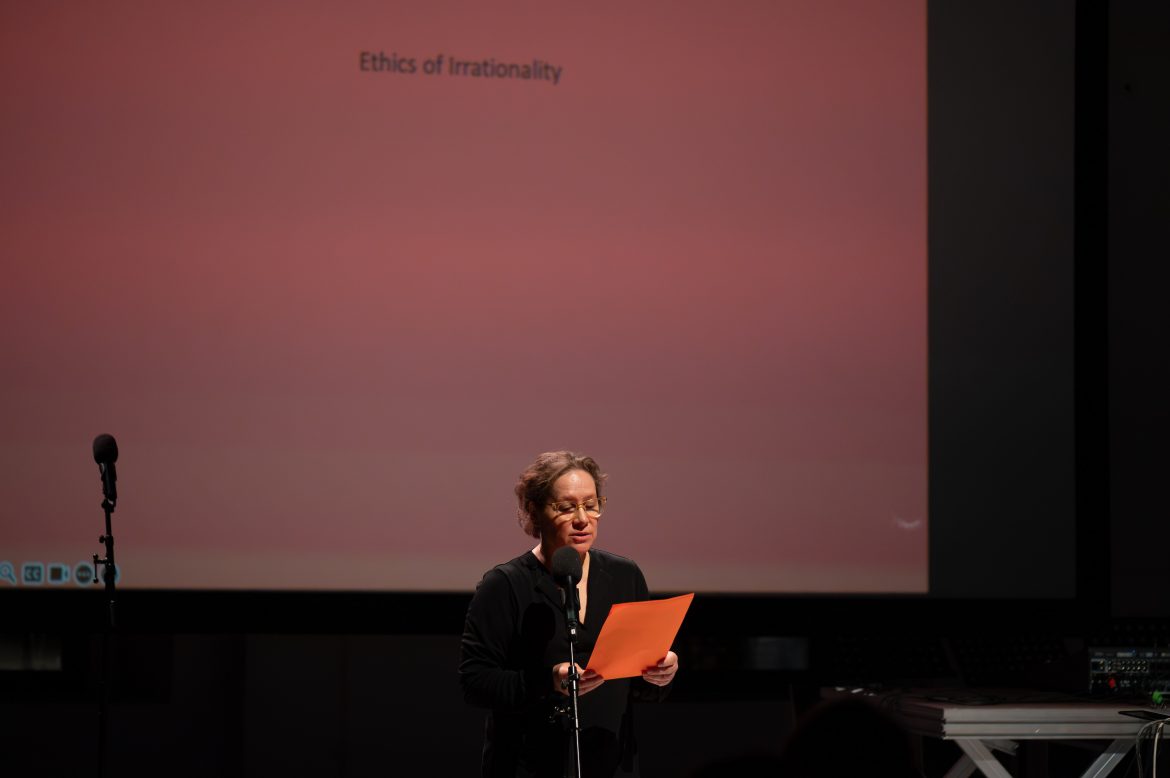
So I was really pleased by this invitation from Irena Pivka to come here and talk at TO)pot Festival because it is always a great privilege to be able to try and experiment with one’s ideas in public. That is also why I do curatorial performances that aren’t just strict paper presentations where I tell what I think or have researched, but where I try things out through performative elements of sounds and doing things and reading things and bringing theory and practise together. So for my contribution at the festival I did a curatorial performance entitled no signal.
The no signal is something I have been thinking about for a while. My first book was called Listening to Noise and Silence, so there was at least rhetorically a difference made between noise and silence, even though in the end the book takes away that difference and says, no, it is a spectrum issue, that noise and silence are an extreme of sound, but they are all sound and actually silence can be very noisy, and noise can be very silent and silencing. So this isn’t a dichotomy, but rather they present us with different ways to think.
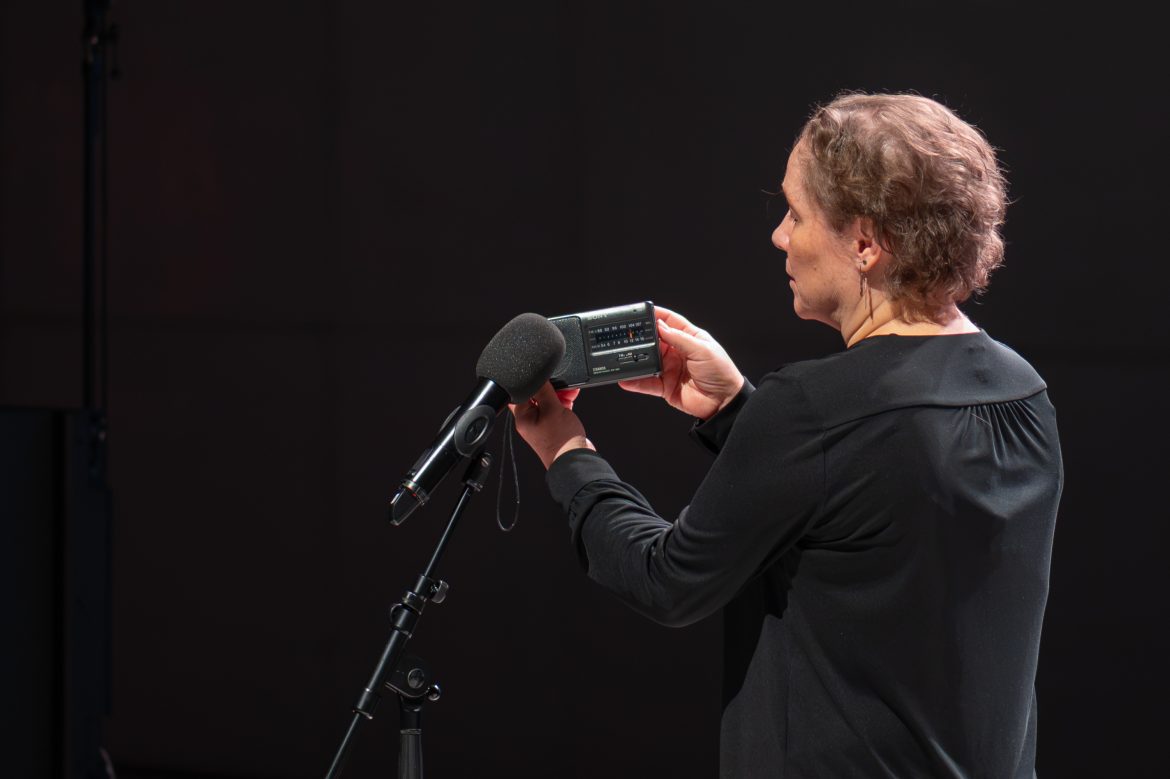
And so the no signal is an idea of. Say if you think of FM radio frequencies and you don’t get a signal, that means that the sound is not allocated and you just get the shhh, you do not get to hear what could be on that frequency. That to me is full of potential, it is full of the potential to think what could be there and it also speaks to a silence that is audible, that we can hear but that does not appear legible or intelligible to us. So we can question our notion of legibility and what we consider silent, i.e. what we think is inaudible, because it might still sound, we just can’t or don’t want to hear it. And on the other hand the untuned frequency is a noise, meaning it is undesirable, we don’t want that radio frequency, we want to turn the dial to one where somebody tells us something semantically that is clear. And this notion of undesirability has again recently moved into the centre of my sensibility with its right wing connotations, and its reminder of a Nazi era were undesirables, Untermenschen, were put into camps, were exterminated, it’s a form of genocide, a genocide we are witnessing now in different places of the world with a terrifying and terrible political irony.
And this undesirability is in the no signal, as the possibility of a silence and what it can portend, what it can bring, what it can make you imagine. And It can also help us think of the so-called undesirable as the very desirable, as the very thing from which listening could hear what we ignore and what we don’t yet hear, but what we might want to engage in in order to understand the world in its crisis, right now. So in a roundabout way that is where the no signal opens up in my performance to reveal the undesirable as the desirable.
This should be a good gateway into a strange question I wanted to pose next about speculation and it’s kind of an epistemic role, not just in art, but maybe throughout art, research, even science, or maybe reasoning, if I speak more generally. So, speculation?
I think I quite like the word speculative, even though it’s a noun, and obviously speculation is more like a verb, like speculating, because I think that’s all we can ever do, and I would prefer people not to think they know what something is, you know, the notion of objectivity and data but keep on speculating. Obviously not in a finance industry sense of the word.
We now live in this AI data world that is ever more driven towards total data – I mean, funding applications, political policies are all driven by AI data, the sense is that we need data sets, we just need data sets, and all will be well. It’s almost like a sort of hyper data, a super modernity of the desire for a calculable world which then led to colonialism or which had colonialism always in its sights already. If we can measure it, we can have it, and this notion that we can have all the data, it’s a little, it’s like a bit of a neurosis or an OCD, you know, like people who start hoovering outdoors, or when you start cleaning and you think it can never be clean enough, so when you want to know the world in that way, you can never know it enough, this notion of comprehension which is at once understanding and grasping, as in taking, as in having, with these data sets, which obviously completely exclude speculation, the body, the uncertain. They are about being absolutely sure even if we are not sure of what, and we’re in a time where we should all become absolutely unsure and not be sure anymore what anything is, even what metrics and data mean.
But I don’t think we, at this moment, are able to have a critical or rejecting stance, we’re so in the grip of it, it’ll take a moment to let go. I mean, if we ever can let go of it, this absolute desire for comprehension, and come to a point where speculation, and even more, maybe anarchic speculations, practise-based speculations might take over the rule of knowledge, that’s why I’m very much in support, say, of practise-based PhDs and practise-based knowledge teaching, where we’re just not sure, because we’re not even sure about the tools we’re using. Where we become uncertain of everything, and that is not nihilism, that is not giving up, that is actually understanding that we cannot be sure, and everything should be an experiment, should be an essay, should be essayer, should be trying, and just a bit more humility about what we might find out as well. So knowledge is not a mastery but a speculative practice.
I think, to go back to a speculative academic framework, I have experienced more of that in England: a desire for pushing boundaries and thinking anew, whereas in my now short time in Germany, where I have moved due to Brexit, I find German thinking highly unspeculative. I find it searches for certainty and legibility, measurability, and maybe that is historically warranted, but I think it has the opposite effect of what is desired, because the certainty leads you down into grundsatz into principle and acceptance of facts and therefore to a lack of thinking and transferability.
Okay, you seem to be suggesting a question further delving into the British, German, some French in there … But I won’t go there.
I also don’t want to set up binaries between the countries, I think my impressions and experiences are very autobiographical, moving through, where I have to get to know myself differently in different contexts, and who I am in these places, and understanding that I am – if I say I’m a being with- … in- sound, and obviously being in London, or being in Berlin, I also change, and then I also have an academic role. I still teach in London, but I also have an academic role in Bern, which is my first foray after thirty years, back into Switzerland. I don’t live there, I just go there, and it’s very interesting that confrontation with that other self, that I also to a degree try to get rid of, bury, deny even.
So you (among others) treat possibility as the ontological status of sound, and that I believe is a huge conceptual move historically speaking. But it’s hard to see how it plays out in everyday life. How would you explain this idea of possibility to a general audience?
Yeah. Maybe very briefly, slightly un-general, the way I sort of came to use possible world theory. In writing my first book Listening to Noise and Silence I became very taken by Maurice Merleau-Ponty‘s phenomenology, not generally phenomenology, I’m not that fond of Heidegger or Husserl, but I really like the very applied, and again Merleau-Ponty was a psychoanalyst, so he was a practitioner, he was a practise-based thinker, and his phenomenology I find very accessible and thinkable, because of that.
He writes about life-worlds, the world we each experience as our real world, and it seemed very clear to me that these life worlds could be thought of as the possible worlds of logic, because they are the what-if of the then what, what if that happens, what could happen, so the game we play in our minds as philosophers or not with ideas such as what if I hadn’t missed that train, or what if I had done this, other things would have opened, new things would have happened, and you can drive yourself mad thinking that way, obviously, such thinking is quite fruitful, because what it can do is, that it can make us think, well okay, so if something different could happen because a missed a train, or a lost a wallet, I can start to understand that the world we live in could be many different ways. And therefore I can start to understand that maybe the world is many different ways, and that the world I experience is just my actuality, it’s just how I experience it, and then we can start to play with these possibilities and simultaneities and understand that our world is not just one way but our perception of it can be just one way, I could experience it differently. Actually I could look slightly to the left or the right, or up or down, and I could slightly listen to something else, and these, the what if-then what, could actually become at least an experiential reality, and I can start to see that the world is more than one thing and see its plurality.
And that to me is a competency or a practise that I would like to be introduced in primary school, or even kindergarten, because it would develop people who understand that we are entrained in one way to understand the world, and we are obviously repeatedly told that that’s the only way the world is, particularly by politicians, who want to persuade us of their particular policies, or particular foreign politics – so that we support it, but that actually we could grow up as more speculative human beings, as more doubtful human beings, living in Merleau-Ponty’s phenomenological doubt all the time, and constantly thinking, well yeah, but it could also be like that, and it might be like that for other people. From such an education and cultural sensibility we could then more easily understand that other people live through their possibilities, and sometimes our possibilities meet, and sometimes they don’t. And if we have that sensibility and understanding, it might sound like a lot of work, to constantly think about how else it could be, but I also think it could give us important insights on ourselves with others and also a lot of joy of understanding more than our limited actuality
I think that understanding, the understanding of the plurality of the world, the plurality of my own possibility, as something, as a way we could see the world, going back to that cultural visuality that designs our norms and reality I spoke about earlier, to resist that and to see and understand from sound the possibility of the world. This would create different relationships, and enable a different politics. So I hope that can explain that actuality, is not the only thing possible, but is what we have chosen, for various reasons, or what we have been trained, for various reasons, to accept as the only reality, in a system that does not invite to think about the plural possibilities, because possibility and plurality complicates us as a to be governed body, as a to be governed subject, a political subject, and it complicates things, because we cannot reach standardisation and so on from possibility, and that is what makes possibility in my view so much more useful as it shows us how to deal with difference, how to deal with how we understand each other, and so on. We are each only a possibility. Meaning there is no hegemony.
I kind of feel an obligation to ask you about this lecture-performance format that you did at the TO)pot festival, but I don’t know, maybe we could also skip it …
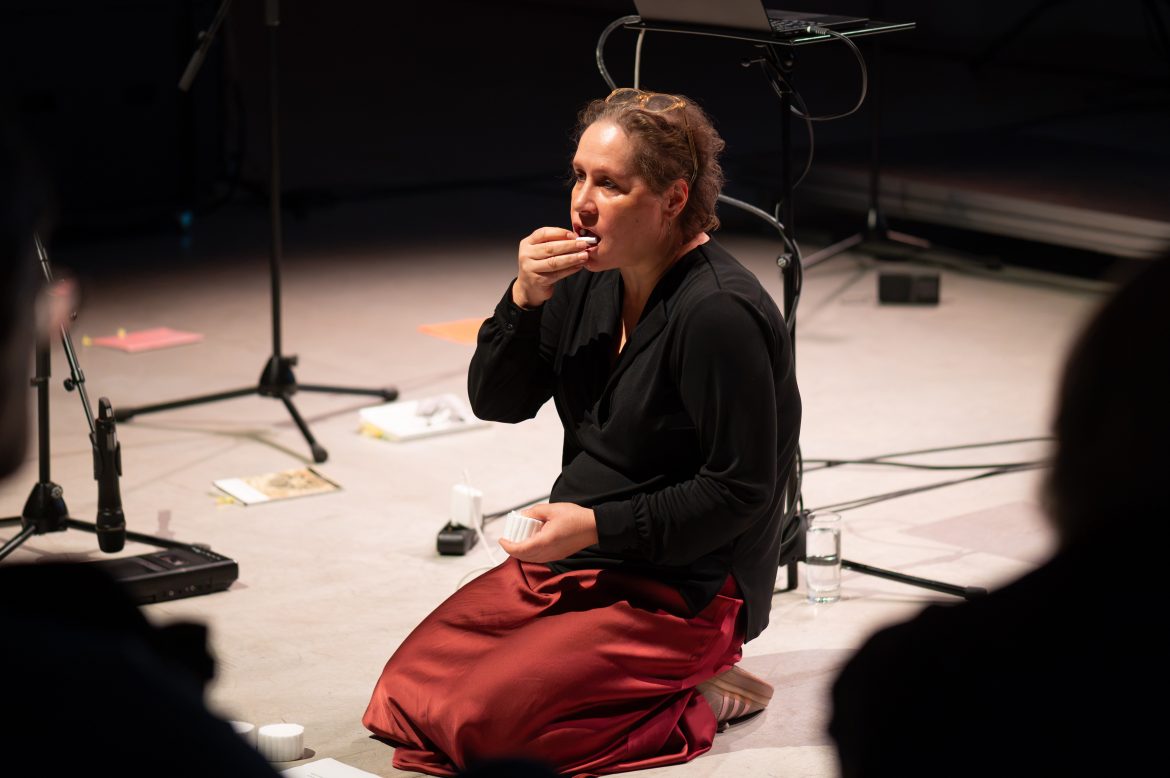
I can just briefly say that what I call a curatorial performance is where I have elements that are like a paper, like you might find in a conference, but they are edited and montaged together with sonic works, readings of literature, poems and so on, and sometimes I do text scores, performative elements, maybe reading or performing something differently and together, and the reason I’m doing it this way, is to break this notion of the theorist and the practitioner, to break this dichotomy and to practise theory, to bring it into the same speculative and practise-based realm as art. in order to form the curatorial element of the curatorial performance, not to hide behind white walls and the authority of a curator, but to actually be there, present on stage, vulnerable, making mistakes, being there as a partner in exchange with an audience, so it’s a performance of the curatorial and therefore also of the power and the governance that that yields, and therefore also a bit of a taking that apart, making that position less powerful maybe even untenable. And it tries to understand knowledge, as I also said earlier, not as something that I have and give, because I don’t have it and I can’t give it, but as something that we can generate together, making an event that creates experiences of knowing, that allows everybody to think from there and live there.
Since what I do this work for is a music platform, are there any favourites you’d share? Just artists you’re maybe a fan of, broadly, not necessarily something you’re going to use in a curatorial sense today, but something that you live with.
It’s interesting, because it changes a lot, and obviously I’m very fond of some of the artists I collaborate with, because then it’s not just a listen and a consumption, it’s actually a thinking with and doing with, so I very much appreciate the work of Kate Carr, I appreciate her performative and compositional work, but I also appreciate her work as a producer – she runs a label, Flaming Pines, and she also does radio work, radio interviews. I think what I appreciate about her work is exactly this diversity of engagements, the different things she does, sort of together, and how she brings them together into, I can’t say an oeuvre, because that is such a modernist and such a genius-y kind of word of another time and of a canon making, but the kind of different engagements through and from sound, and how she brings them together, I think I identify with that, I like that very much.
In a more historical sense, I really like the work of Beatriz Ferreyra, I like, again, we spoke about autobiography, how she works with the voice and with tape where she makes composition for the voice in part by destroying the voice – not destroying the voice, but destroying the semantic of the voice, the signal, by working with voice to tease out something else, maybe the no signal, which I would sort of consider a very feminist move, a body that we then hear, and also, for example, I think of her work Echoes from 1978, where she works with Argentinian and Brazilian folksong, very important for the production of national identity, almost, anthems, songs, and then we hear them very differently, cut up and opened up to the elements of language that sound it new from the non legible. That I really appreciate. I also really appreciate the work of Annea Lockwood, because of how she works, with these different groups like, I think, Apartment House ensemble, MAZE collective and others, where she doesn’t write a score and then give them a score, and, oh, you do that now, you interpret, but where the meeting, meeting with them, being in conversation and getting to a composition through that dialogue and through stones or insects or common concerns, is at the centre. So there’s not the composer and the performer or the interpreter dichotomy, but there is more of a collaborative or dialogue setup, which I really like, and hearing her works done in different settings and hearing how they always change, means there is no one right way to play it and thus no claim can be made of one being the best interpretation. Instead there is a lot of agency, agency for us to imagine it differently. There are many more artists and musicians, but I suppose these are the sort of stuff I like … do you want more?
I should hurry, but maybe just, you know, you liked a performance by a contemporary artist lately that was not within a new music or contemporary classical music framework?
Do you mean more a visual arts performer?
No, no, no, no, I’m interested in music primarily …
I suppose one performance that I found, yeah, I’ve got two … A performance I found very strong that I saw at Cafe Oto was Mariam Rezaei, who is a DJ, and I really loved the energy, I loved also, I suppose, the claiming a little bit of a masculine DJ space by this very confident woman, and how that translated into sound and how it grabbed me into the force field she produced through the DJ-ing. And then there was a performance which was part of a launch of the Cassette Album, it’s Pisitakun Kuantalaeng, he just calls himself Pisitakun, he’s from Thailand, and for the Cassette Album I had sent him a score, and he responded to this score with an extremely strong and powerful and also political track and then he did a performance at KM28 in Berlin, and it was amazing, because he played on the khaen, a traditional south-east Asian mouth organ, but he plays it within this framework of German new music, which is itself a problematic term, and it is clearly a political instrument of protest, and revolt in Thailand. And he just stood there like really strong and taking space in a kind of good way, and he just filled the room with this instrument, and you could barely stop him, he just, went on and on and I thought it was amazing how he changed the room into this musical, but also political, and very visceral, physical way, there wasn’t really a rhythm, and yet it really grabbed you with its …
Intensity.
Yes, absolutely, intensity.
You’ve kind of offered me this throughout the conversation a couple of times. So, if we would imagine all the current discourse about artificial intelligence as just sound reverberating through the world … There is a lot of negative context there, but if there was something about it that actually inspired a positive kind of approach to this discourse in you, what would that be?
I mean, this is a really, really difficult area. And I think the difficulty arises not even necessarily by what AI does. It arises by who is in charge of it. Which are, on the whole, very narcissistic white men with the same colonial thought structures as we had in the 18th century. And if you could deliver me the potential of the AI without the environmental destruction in terms of water and electricity … and if you could deliver it to me with a highly ethical and responsible framework of what it will be used for … and with the capacity to not use it for anything else, which humans have never shown, because humans do what they can do and they do not know how to not do what they can do – which is sort of another subject, but very interesting … and if you could guarantee me … if there was a symmetry through the world of AI … which would only be possible if the internet, the digital sphere from which AI draws its patterns and frequencies was symmetrical, i.e. it was inhabited by knowledge from indigenous communities, from communities all over the world, women, men, black, brown, anything, disabled people, people who feel differently, to the same extent … so if the pool of knowledge and knowing and thinking AI could draw on was not homogeneous or almost homogeneous … maybe if all those criteria, and maybe there are some more that I can’t think of right now … but if all of those could be absolutely guaranteed …
And they’re most important.
And they’re really important, and in fact if we would live in a sonic possible world, without the boundaries of nationalism, without right-wing politics, without the idea of conquering. I think AI could be a useful element, a useful collaborator to humanity. It’s not a tool, it’s most decidedly not a tool, because we’re not really using it, it is using material we have put into the digital sphere, and that’s where the problems start. But because none of this can ever be guaranteed, and none of this will ever happen, the benefits AI has, say, for cancer research – I heard a very persuasive talk about skin cancer and the pattern recognition of AI in relation to skin cancer, and I can really understand that and the desire for medicine to use that. But because all those other parameters cannot be guaranteed, we would be foolish to think it works. What is, of course, comical is that the people who most believe in it are, I think, men between forty and seventy. They really believe that this is the future, whereas my children, for example, who are teenagers, are much more … meh. And that is interesting. It’s really interesting where, who, what demographic believes in an AI future. And obviously financially it’s not working out yet, so all the companies who sack people because they can now do it with the free AI, they might in ten years’ time have to rethink their position quite dramatically, because there is no financial model where it works as yet.